R2OT
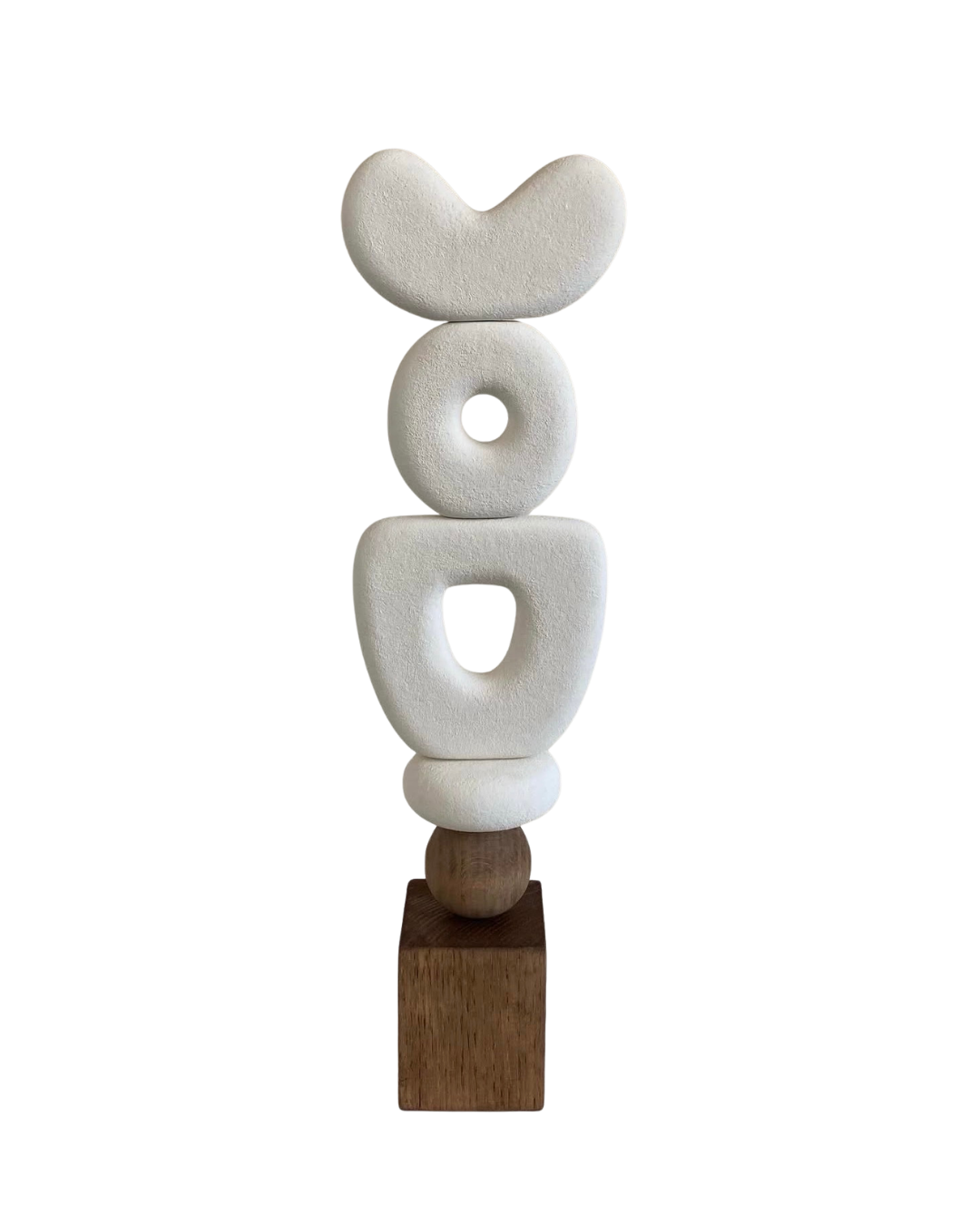
AMÉLIE DAUTEUR – "Satomi"
2026
4/12
Painted ceramic on a wooden base
Height: 43 cm
SATOMI
The name satomi draws on two everyday characters most often rendered as 里美: sato (里), the village, the native place, the human settlement set against the wild mountain (yama) in Japan's oldest spatial pairing — and mi (美), beauty. Sato carries a particular warmth in Japanese: it is not merely administrative territory but the remembered place of origin, the word that survives in satogaeri (里帰り), the return home, and in furusato, the native village held in memory long after one has left it. Beauty, in this name, is not abstracted from place but rooted in it — a beauty that belongs to where one is from.
The pairing has old ground beneath it. Sato appears throughout the Man'yōshū, Japan's earliest poetic anthology, compiled in the eighth century, where the village is repeatedly the site of longing, the place a traveler looks back toward or a lover waits within — never neutral ground, always charged with attachment. Satomi inherits this charge in miniature, folding an entire poetics of homeland into two syllables.
With this totem, Amélie Dauteur takes up a beauty that cannot be extracted from its origin — not beauty as universal ideal, but beauty as belonging, inseparable from the ground that first held it. Where himari turns toward a light it did not choose, satomi remains rooted in a place it did not choose either, and finds its form there.
SATOMI does not ask to be beautiful apart from where it comes from. It asks: what place made your beauty possible?
Couldn't load pickup availability
Share

-
BEFORE R2OT
Trained at the Academy of Fine Arts in Warsaw, where he specialized in sculpture, Krzysztof Renes creates works that exist at the boundary between figure and abstraction, tradition and modernity. His works are held in collections in Poland and internationally.
-
WHY DO WE LOVE IT
Because his work holds two worlds at once — the hand of a craftsman and the mind of an engineer, the human figure and pure abstraction.
-
OUR ADVICE
Place your sculpture on a nice postument, preferably mixed with darker tones.
Krzysztof Renes
Krzysztof Renes is one of the most talented and recognizable sculptors of the younger generation, who implements and develops his own techniques and reaches for industrial solutions, confronting them with the traditional language of sculpture. All his works are a form of dualism, operating on the border between figure and abstraction, tradition and modernity, culture and
nature. He explores the two-dimensional space in sculpture, where flat and three-dimensional sketching, drawing and sculpture are the same, 2D = 3D.In his works, he looks for cultural features that reflect their origins and boundaries in technological and cultural dimensions. These considerations are particularly evident in the Universale series. And although almost all works refer to the human image, for the author his art is not exclusively figurative art. The processed body here is a carrier of content, symbols or
emotions - a sign in space. Commercially, he collaborates with the sports market and business, creating awards and statuettes for elite events such as the Forbes 50 Most Influential People in Polish Sports or the Imagine Yourself film competition sponsored by the Starak Family Foundation. His sculptures feed art collections in Poland and abroad.
Krzysztof Renes
-
KRZYSZTOF RENES – "Spatial Penetration I Opus 42"
Regular price €3.771,95 EURRegular priceSale price €3.771,95 EUR -
KRZYSZTOF RENES – "Superluminal observer I Universale Cycle"
Regular price €5.185,95 EURRegular priceSale price €5.185,95 EUR